
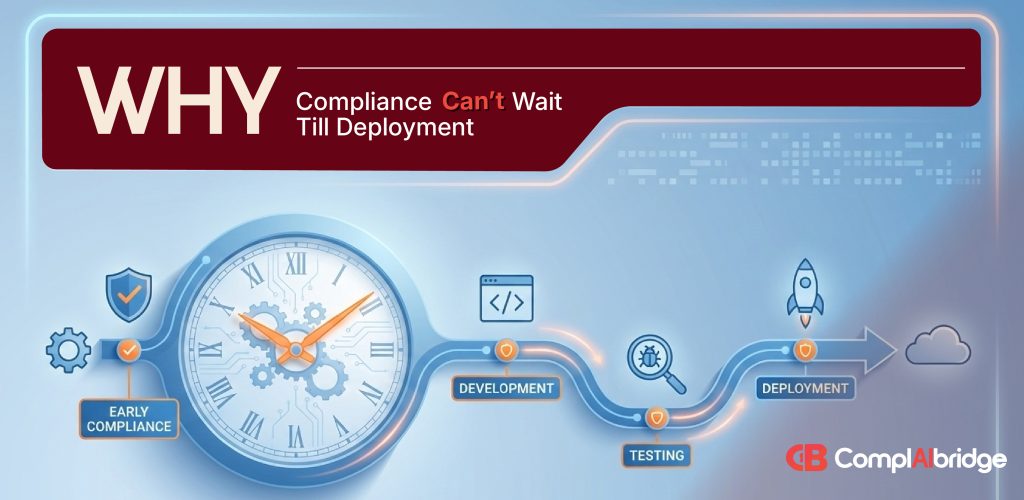
Why Compliance Can’t Wait Till Deployment
For years, compliance has been treated as a finish-line activity. Build the product. Deploy the system. Then run checks, audits, and controls to make sure everything is “compliant enough.”
That approach no longer works.
In a world of AI-driven systems, continuous releases, and tightening regulations, waiting until deployment to think about compliance doesn’t just slow you down, it actively puts your business at risk. Platforms like Complaibridge exist precisely because compliance today has to be continuous, not retrospective.
Compliance Is No Longer a Post-Production Checklist
Modern systems are no longer static. They learn, adapt, and make decisions continuously. When compliance is applied only at deployment, teams are effectively trying to retrofit controls onto something that is already live, already processing data, and already influencing outcomes.
This is especially risky for regulated industries like BFSI, healthcare, and critical infrastructure, where regulators increasingly expect proof of how decisions were made—not just what the final output was.
By the time compliance is “checked” at deployment, the most important questions have already gone unanswered:
- Were data sources governed correctly?
- Were decision paths explainable?
- Were risks identified and mitigated during development?
Without compliance embedded earlier in the lifecycle, these answers are difficult, if not impossible, to reconstruct later.
Regulators Are Looking for Process, Not Just Proof
Regulatory expectations have shifted. It’s no longer enough to show that a system meets requirements at a single point in time. Regulators now want visibility into the entire lifecycle, design decisions, approvals, changes, exceptions, and responses.
Frameworks like DORA, GDPR, EU AI Act, and sector-specific guidelines all emphasize accountability, traceability, and auditability across the system lifecycle. That accountability cannot be reconstructed after deployment. It has to be built in.
This is why approaches that embed compliance into build, run, and assurance, such as those enabled by Complaibridge’s continuous compliance model are becoming essential rather than optional.
Late Compliance Is Expensive Compliance
Treating compliance as a final gate almost always leads to rework. Features are rolled back. Models need retraining. Data pipelines are redesigned. In some cases, entire releases are paused or reversed.
Beyond cost, this erodes trust between engineering, security, compliance, and leadership teams. What should have been a controlled release turns into a firefight.
Early compliance shifts the conversation from “Is this allowed? ” to “How do we design this correctly from day one? ”
AI Systems Make Delayed Compliance Dangerous
Agentic and automated systems don’t wait for human review at every step. They act. They decide. They adapt.
If compliance controls only appear at deployment, organisations lose visibility into what happens between decisions, especially as systems evolve post-release. Without continuous governance, detecting drift, bias, or unintended behaviour becomes harder, and post-incident investigations become far more severe.
This is why platforms like Complaibridge focus on orchestrating compliance across systems as they operate, not just validating outcomes after the fact.
Compliance-by-Design Enables Faster Deployment
There’s a common misconception that early compliance slows teams down. In reality, it does the opposite.
When guardrails are built into development pipelines, teams move faster because expectations are clear. Developers know the boundaries. Security teams know where controls live. Compliance teams gain real-time visibility instead of last-minute surprises.
Compliance becomes an enabler, not a blocker.
From “Deploy First” to “Compliant from Day One”
The organisations that succeed in regulated environments aren’t the ones that deploy first and fix later. They’re the ones that treat compliance as a design principle, not a deployment task.
By embedding compliance early across build, run, and assurance, businesses gain resilience, regulator confidence, and long-term scalability.
Because in today’s regulatory landscape, compliance isn’t something you prove at the end.
It’s something you demonstrate every step of the way.

