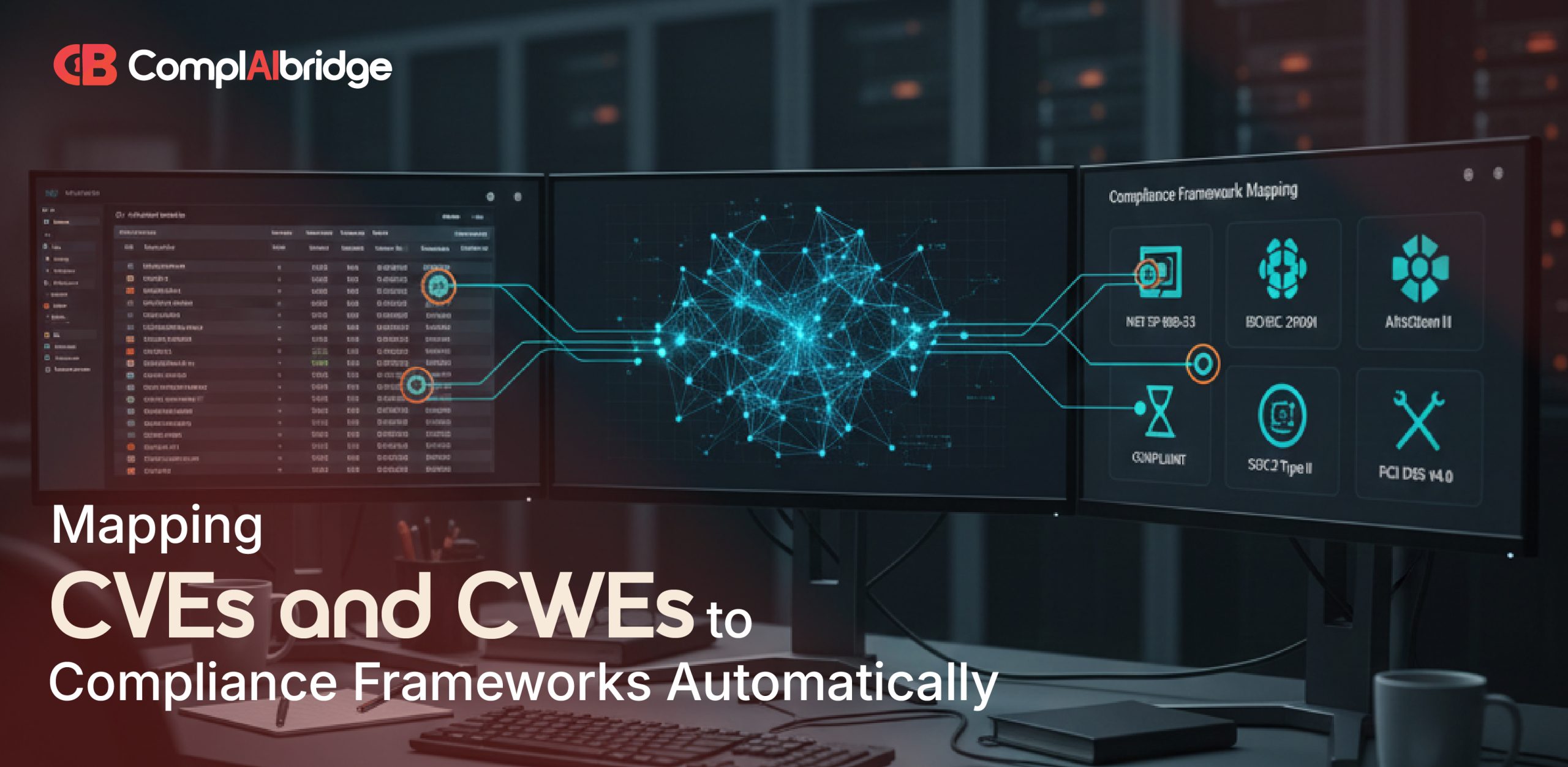
Security teams are drowning in vulnerability data. Compliance teams are drowning in control requirements. And somewhere between CVEs, CWEs, and regulatory frameworks, both teams are expected to produce clear, defensible answers for auditors and regulators.
Manually connecting vulnerabilities to compliance obligations has never been sustainable. As attack surfaces grow and regulations tighten, organisations need a way to automatically map technical vulnerabilities to the compliance frameworks that govern them.
This is exactly the gap ComplAIBridge is designed to close.
The disconnect between security findings and compliance evidence
CVEs and CWEs live in the world of security operations. They describe real, technical weaknesses such as misconfigurations, insecure code patterns, and exploitable flaws. Compliance frameworks, on the other hand, speak a very different language. They focus on controls, policies, risk management, and accountability.
The problem isn't a lack of data. It's a lack of translation.
When a vulnerability scanner flags a critical CVE, security teams know it's serious. But compliance teams still have to answer harder questions: Which regulatory controls does this impact? Does this violate ISO 27001, SOC 2, PCI DSS, or DORA? Is this a control failure, a risk exception, or an acceptable residual risk?
Without a systematic way to connect vulnerabilities to compliance controls, organisations fall back on spreadsheets, tribal knowledge, and manual interpretation. These approaches don't scale, and they rarely stand up to audit scrutiny.
Why manual mapping fails at scale
Manual CVE-to-framework mapping breaks down for three reasons.
First, the volume is unmanageable. Thousands of CVEs are published every year, many of them with overlapping root causes. Expecting teams to individually assess and map each one is unrealistic.
Second, the mapping itself is subjective. Two analysts may map the same vulnerability to different controls, creating inconsistency and confusion during audits.
Third, timing matters. Regulators increasingly expect near real-time visibility into risk posture. If mappings lag behind vulnerability disclosures, compliance reporting becomes outdated almost instantly.
This is where automation becomes essential, not optional.
The role of CWEs as the missing link
CWEs change the game.
While CVEs describe individual vulnerabilities, CWEs categorise underlying weakness patterns such as improper input validation, weak authentication, or insufficient logging. These systemic weaknesses align far more naturally with compliance controls than one-off vulnerabilities ever could.
Compliance frameworks are built around managing classes of risk, not chasing individual flaws. By anchoring compliance mappings at the CWE level, organisations can create stable, reusable relationships between technical weaknesses and regulatory requirements.
When a new CVE is disclosed, it can inherit the compliance implications of its underlying CWE automatically and consistently.
How ComplAIBridge automates CVE and CWE mapping
ComplAIBridge operationalises this approach through its compliance orchestration layer.
First, vulnerabilities are continuously ingested from scanners, threat intelligence feeds, and asset inventories. Each CVE is enriched with contextual metadata, including severity, exploitability, asset impact, and its associated CWE.
See it in action
See how ComplAIbridge fits your stack
Book a 20-minute walkthrough - no deck, no sales cycle, just the product.
Book a DemoSecond, CWEs are mapped within ComplAIBridge to specific control objectives across major frameworks such as ISO 27001, SOC 2, PCI DSS, NIST, and DORA. These mappings are curated, version-controlled, and aligned to how auditors and regulators interpret control effectiveness.
Third, ComplAIBridge translates live vulnerability data into real-time compliance impact. When a CVE is detected, teams can immediately see:
- Which regulatory controls are affected
- Whether remediation, acceptance, or escalation is required to maintain compliance
This turns vulnerability management from a reactive security exercise into a proactive compliance signal.
Why this matters for audits and regulators
Auditors don't want raw vulnerability outputs. They want evidence that controls are effective and risks are managed appropriately.
With automatic CVE and CWE mapping, ComplAIBridge enables organisations to demonstrate not just that vulnerabilities were detected, but that they were assessed in a regulatory context, prioritised correctly, and remediated with documented outcomes.
More importantly, it creates traceability. Every vulnerability is linked to:
- A recognised weakness category
- One or more compliance controls
- A clear remediation or risk decision
Accepted, mitigated, or deferred actions are documented with context, justification, and timestamps, all of which are critical under modern regulatory expectations.
From point-in-time reporting to continuous compliance
Traditional compliance reporting offers snapshots. ComplAIBridge enables continuity.
As new vulnerabilities emerge or environments change, compliance posture updates automatically. Teams no longer wait for quarterly reviews or annual audits to uncover gaps. They see compliance impact as it happens.
This is essential for organisations operating modern, fast-changing infrastructure where yesterday's compliant system may not be compliant today.
Making security and compliance speak the same language
At its core, automatic mapping solves a communication problem.
Security teams continue to operate using CVEs and CWEs. Compliance teams continue to work with controls, frameworks, and audit evidence. ComplAIBridge acts as the translation layer, ensuring both sides see the same risk through the lens that matters to them.
The result is fewer surprises, stronger audit outcomes, and a compliance posture grounded in real operational data rather than static documentation.
Conclusion: Automation is no longer optional
As vulnerability data grows and regulatory expectations rise, manual mapping becomes a liability. Organisations that rely on spreadsheets and human interpretation will struggle to keep pace.
Automatically mapping CVEs and CWEs to compliance frameworks is no longer just a technical enhancement. It is a foundational capability for continuous compliance, operational resilience, and regulator confidence.
Because when vulnerabilities are inevitable, visibility, traceability, and accountability cannot be optional.
Keep reading
Get Early Access
Ready to make compliance
part of how you build?
Get in touch and we'll show you exactly how ComplAIbridge fits your stack, your team, and your frameworks.
No deck. No sales cycle. Just the product.