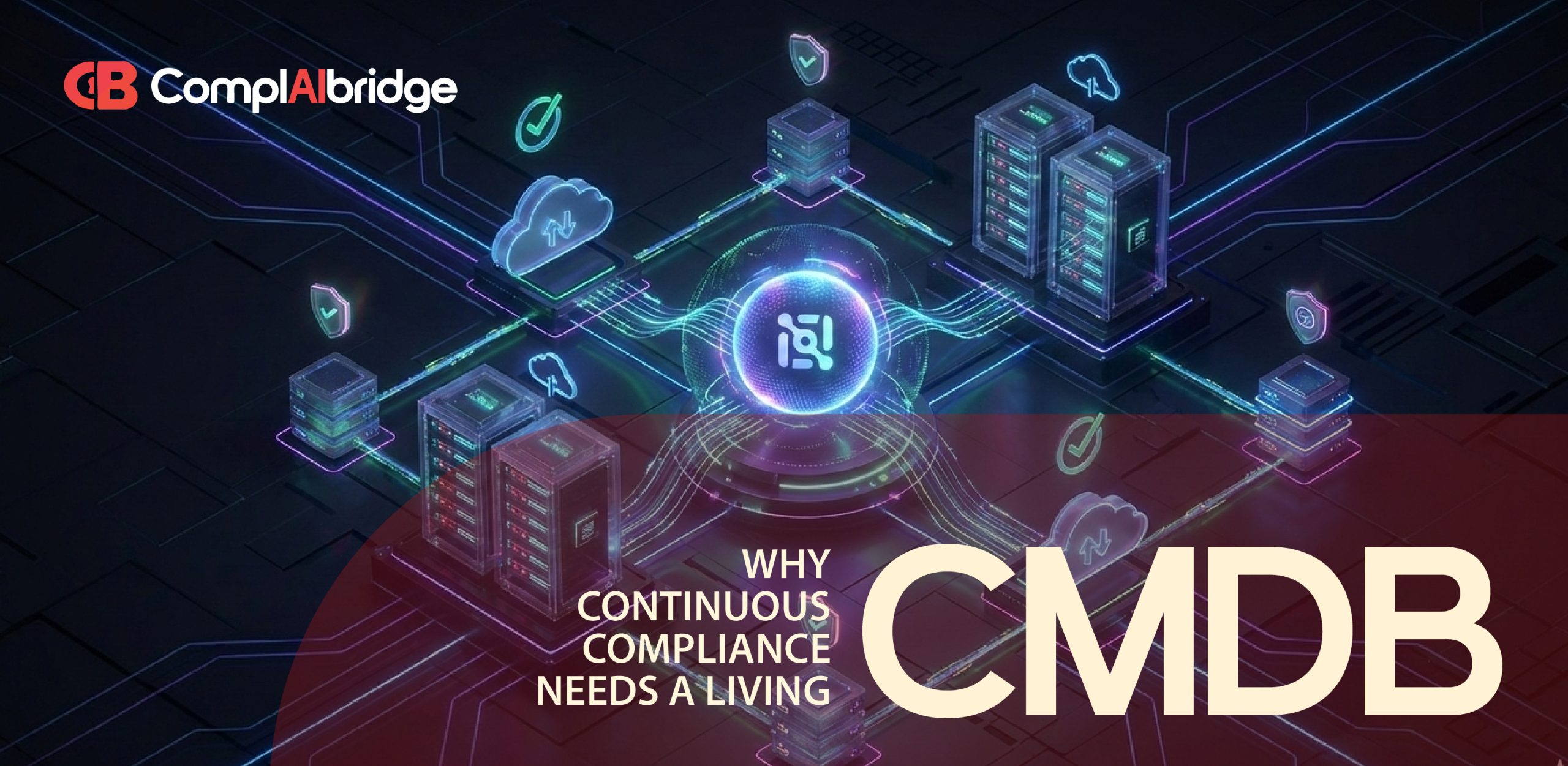
Most organisations have a CMDB (Configuration Management Database). But few actually use it for compliance.
In many environments, the CMDB is treated as a static inventory, updated periodically and dusted off during audits. Meanwhile, the infrastructure it's meant to describe is constantly changing. Services are deployed, dependencies shift, ownership changes, and cloud resources appear and disappear.
This gap between documented assets and real systems is one of the biggest blockers to continuous compliance.
The compliance cost of a static CMDB
Compliance frameworks are built on scope and accountability. Controls apply to specific systems. Risks are assessed against defined services. Evidence is expected to reflect how controls operate in reality, not how they looked six months ago.
When the CMDB falls out of sync, compliance teams are forced to guess. Scope expands unnecessarily. Evidence is duplicated. Controls are applied broadly to compensate for uncertainty. Over time, compliance becomes heavier, slower, and more fragile.
Auditors may not immediately see the CMDB gaps, but they feel the symptoms: inconsistent evidence, unclear ownership, and difficulty explaining how changes were governed.
From asset inventory to living context
A living CMDB is fundamentally different from a static one. It doesn't just list assets; it reflects how systems evolve over time.
Instead of relying on periodic manual updates, a living CMDB stays aligned with reality by continuously absorbing signals from cloud platforms, deployment pipelines, change tickets, and operational tools. As services change, the CMDB changes with them.
This matters because compliance is not a one-time exercise. It's a continuous relationship between systems, risks, and controls. Without up-to-date asset context, that relationship breaks down.
Where ComplAIBridge fits in
ComplAIBridge treats the CMDB as a foundational input to continuous compliance, not a passive reference.
See it in action
See how ComplAIbridge fits your stack
Book a 20-minute walkthrough - no deck, no sales cycle, just the product.
Book a DemoBy connecting live CMDB data into its compliance orchestration layer, ComplAIBridge ensures that controls, risks, and evidence are always tied back to the systems they actually govern. When an asset changes, its compliance impact is immediately visible. When ownership shifts, accountability updates automatically.
This removes a huge amount of manual interpretation from compliance work and replaces it with traceable, system-driven context.
Enabling compliance before production
One of the most common compliance failures is timing. Risks are often discovered late, when systems are already deployed and changes are expensive.
A living CMDB helps move compliance upstream. Because asset context is available throughout the SDLC, ComplAIBridge can surface compliance implications during design, build, and change, not just at deployment or audit time.
This allows teams to address issues earlier, with less disruption and far fewer exceptions.
Better audits start with better asset truth
Auditors don't just want to know what exists today. They want to understand what changed, when it changed, and how those changes were controlled.
A living CMDB, combined with ComplAIBridge, provides that continuity. Changes are linked to assets, controls, and evidence as they happen, rather than being reconstructed after the fact. Audit conversations shift from explanation to verification.
Continuous compliance depends on living systems
As environments become more dynamic and regulatory expectations rise, static CMDBs simply can't keep up. They capture a moment in time, while compliance is judged over time.
Continuous compliance requires living systems that reflect reality. A living CMDB, connected through ComplAIBridge, provides the asset truth that makes that possible.
Because in a world of constant change, compliance can't rely on static records.
Keep reading
Get Early Access
Ready to make compliance
part of how you build?
Get in touch and we'll show you exactly how ComplAIbridge fits your stack, your team, and your frameworks.
No deck. No sales cycle. Just the product.