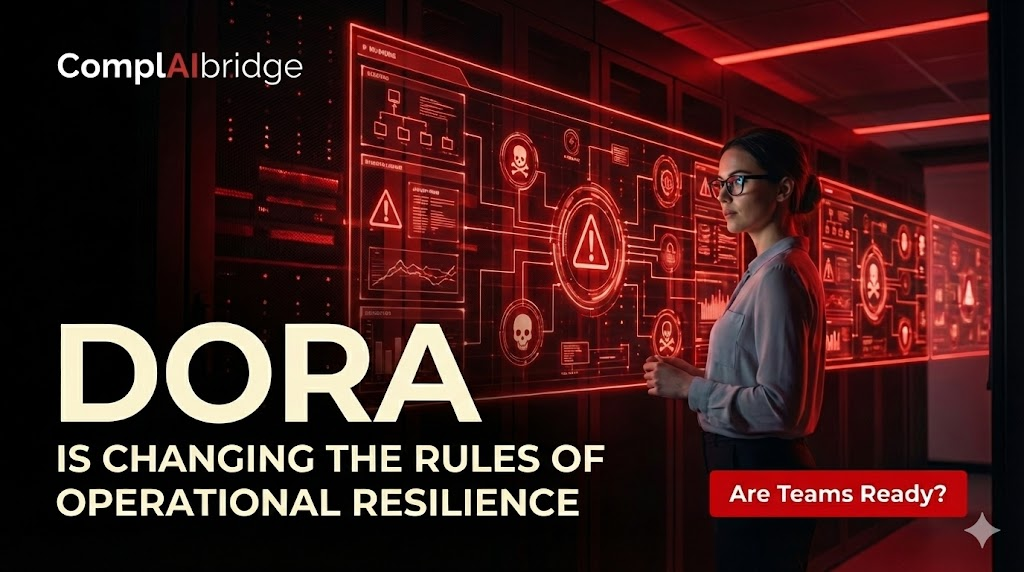
For years, most financial institutions have treated operational resilience as something you prepare for periodically. You run audits. You update policies. You pass assessments. Then you move on until the next cycle begins. The Digital Operational Resilience Act, or DORA, quietly but decisively changes that rhythm. Formally adopted in 2022, in force from 2023, and fully applicable from January 2025, it is not just another regulatory checkbox. It signals a deeper shift in how organisations are expected to manage risk, handle incidents, and prove that they can keep operating under pressure.
For many teams, the real challenge is not understanding what DORA says. The challenge is grasping how much it changes the way resilience must be built and demonstrated every single day.
Why DORA feels different
Until now, operational resilience lived across a patchwork of guidelines and best practices. DORA brings all of that into a single, enforceable regulation with real consequences. More importantly, it changes three things at a fundamental level.
First, DORA demands continuous assurance, not periodic proof. Resilience can no longer be something you demonstrate once a year during an audit. It has to be visible all the time, tied to real systems and real services. This is where approaches built around continuous evidence collection, such as those used by Complaibridge-style platforms, become essential.
Second, it introduces full lifecycle accountability. It is no longer enough to show policies and post-production controls. Regulators now expect to see how risks were identified, tested, and mitigated across the entire lifecycle, from design and build through to operations and change. This directly aligns with the shift toward embedding compliance into the SDLC, rather than managing it only after deployment.
Finally, DORA forces deep visibility into dependencies. Organisations must understand how services connect, how failures spread, and what the true blast radius of an incident looks like across internal and third-party systems. Without strong CMDB integration and service mapping, this is extremely difficult to demonstrate in practice.
In simple terms, DORA expects organisations to prove resilience, not just promise it. That expectation is reshaping how compliance and security platforms like Complaibridge are being evaluated.
Preparing for DORA without adding more manual work
The organisations making the most progress are not responding with more spreadsheets or larger compliance teams. Instead, they are shifting left and using the data they already generate across requirements, designs, changes and operations to spot risk earlier and prove control later.
See it in action
See how ComplAIbridge fits your stack
Book a 20-minute walkthrough - no deck, no sales cycle, just the product.
Book a DemoThis approach allows teams to trace issues back to the source, understand impact accurately, and generate audit-ready evidence as work happens. It turns operational resilience into something that is built into daily work, not reconstructed after the fact. This shift is exactly what modern compliance engines like Complaibridge are designed to support.
Where platforms like Complaibridge fit in
This shift is already being reflected in how modern platforms are starting to support DORA requirements. Platforms like Complaibridge are designed around the idea that compliance should be a byproduct of how you build and run systems.
By connecting SDLC artefacts, assets, vulnerabilities and incidents into one traceable chain, organisations can demonstrate the type of lifecycle accountability that DORA expects. Scanless risk detection allows teams to identify issues earlier, rather than waiting for production scans. COAR turns incidents into governed, auditable workflows with clear ownership and evidence. This directly supports the incident response and documentation standards DORA introduces. And by unifying SDLC, CMDB and observability data, teams gain a real-time view of dependencies and resilience posture, something regulators will increasingly expect to see.
The goal is not to replace existing tools, but to finally connect them into a coherent resilience story. This is where systems like Complaibridge are increasingly being positioned.
The bigger shift DORA is driving
DORA is accelerating a transition that was already underway, from compliance as documentation to compliance as continuous operational resilience. With the January 2025 enforcement deadline approaching, organisations are now under real pressure to operationalise this shift, not just plan for it.
The organisations that succeed will be the ones that break down silos between engineering, security, risk and audit, build traceability into the lifecycle, and use automation to maintain evidence instead of recreating it later. This is the direction platforms such as Complaibridge are actively enabling.
DORA raises the bar, but it also creates clarity. With the right approach, resilience can become something teams demonstrate every day, not something they scramble to prove when scrutiny arrives.
Keep reading
 Insights
Speed in Compliance: Why Faster Isn't Always Better
We celebrate speed everywhere. But in compliance, speed tells a very different story.
 Product
DevGovOps in Practice: How Complaibridge Makes It Work
DevGovOps is easy to agree with in principle. The challenge begins when this idea meets reality.
 Engineering
DevGovOps: The Missing Layer in Modern Software Delivery
DevSecOps brought security into the development lifecycle. It took a decade and it changed everything. Governance is next.
Get Early Access
Ready to make compliance
part of how you build?
Get in touch and we'll show you exactly how ComplAIbridge fits your stack, your team, and your frameworks.
No deck. No sales cycle. Just the product.